About Kitchen Knives
If you believe that all steels and knives are the same you would be mistaken. The quality of knives and the performance of the knife is very much linked to the materials it is made from, the process the knife goes through being built and the workmanship behind the brand.
Blade manufacturing
Steel blades can be manufactured either by being forged or stamped.
-
Forged or hot forged blades are made in an intricate, multi-step process, often by skilled manual labor. A chunk of solid or powdered steel alloy is heated to a high temperature, and pounded while hot to form it. The blade is then heated above critical temperature (which varies between alloys), quenched in an appropriate quenchant, and tempered to the desired hardness. After forging and heat-treating, the blade is polished and sharpened. Forged blades are typically thicker and heavier than stamped blades, which is sometimes advantageous. Brands that are made this way include Wusthof, Bismarck and Brasilia
-
Stamped blades are cut to shape directly from cold-rolled steel, heat-treated for strength, then ground, polished, and sharpened. Though they are not preferred by most professional chefs, several popular knife brands, such as some Global and Shun, do use stamped and heat-treated blades in their premium knives. Stamped blades can often, but not always, be identified by the absence of a bolster.
Blade Material
-
Carbon steel is an alloy of iron and carbon, often including other alloys such as vanadium and manganese. Carbon steel commonly used in knives has around 1.0% carbon, and holds its edge well. Carbon steel is normally easier to resharpen than most stainless steels, but is vulnerable to rust and stains. The blades should be cleaned, dried, and lubricated after each use and new carbon-steel knives may impart a metallic or "iron" flavour to acidic foods, though over time, the steel will acquire a patina of oxidation which will prevent corrosion. Good carbon steel will take a sharp edge, but is not so hard as to be difficult to sharpen, unlike some grades of stainless steel.
-
High carbon stainless steel normally refers to higher-grade, stainless steel alloys with a certain amount of carbon, and is intended to combine the best attributes of carbon steel and ordinary stainless steel. High carbon stainless steel blades do not discolour or stain, and maintain a sharp edge for a reasonable time. Most 'high-carbon' stainless blades are made of higher-quality alloys than less-expensive stainless knives, often including amounts of molybdenum, vanadium, cobalt, and other components intended to increase strength, edge-holding, and cutting ability.
-
Laminated blades combine the advantages of a hard, but brittle steel which will hold a good edge but is easily chipped and damaged, with a tougher steel less susceptible to damage and chipping, but incapable of taking a good edge. The hard steel is sandwiched (laminated) and protected between layers of the tougher steel. The hard steel forms the edge of the knife; it will take a more acute grind than a less hard steel, and will stay sharp longer.
-
Ceramic knives are very hard, made from zirconium oxide, retain their sharp edge for a long time, are light in weight, do not impart any taste to food and do not corrode. Suitable for slicing fruit, vegetables and boneless meat. Ceramic knives are best used as a specialist kitchen utensil. Recent manufacturing improvements have made them less brittle.
Handles
-
The handles of kitchen knives can be made from a number of different materials, each of which has advantages and disadvantages.Wood handles provide good grip, and most people consider them to be the most attractive. They are, however, slightly more difficult to care for as they must be cleaned more thoroughly. Most wood handles, especially those of ordinary varnished hardwood, do not resist water well, and will crack or warp with prolonged exposure to water. They should be hand-washed for that reason.
-
Plastic handles are more easily cared for than wooden handles and do not absorb micro organisms. However, plastics may also be less resistant to ultraviolet damage and may become brittle over time, resulting in cracking. Some plastics are also slippery in the hand. The material is lighter than most other materials, which may result in a knife that is off-balance or too light for some tastes.
-
Composite knives are made from laminated wood composites impregnated with plastic resin. This is primarily DymondWood by Rutland Plywood Corporation; the same product is sold under brand names such as Pakkawood, Staminawood, Dymondwood, and Colorwood.[3] Composite handles are considered by many chefs to be the best choice because they are as easy to care for and as sanitary as plastic, they have the appearance, weight, and grip of hardwood, and are more durable than either. They often have a laminated, polished appearance, and may have intense or varied coloring.
-
Stainless steel handles are the most durable of all handles, as well as the most sanitary. Some people, however, that they are slippery in the hand, especially when wet. To counter this, many premium knife makers make handles with ridges, bumps, or indentations to provide extra grip. One disadvantage of some all-metal handles is that knife weight usually goes up considerably, affecting the knife's balance and increasing hand and wrist fatigue. Some knife manufacturers have begun addressing this issue by producing hollow-handled knives.
Types of Edges
Most knives have a standard straight edge blades but there are other types of blades.

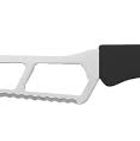
Serrated blade knives have a wavy, scalloped or saw-like blade. Serrations help when cutting things that are hard on the outside and soft on the inside (such as bread or tomatoes); the saw-like action breaks the surface more easily than anything except the very sharpest smooth blade. Serrations are often used to improve the cutting ability of a less-expensive blade not capable of taking and keeping a sharp edge, usually having a thin, polished blade designed to minimise friction.
Granton Edge
Granton knives have semi-circular scallops ground into the edge that alternate on either side of the knife and extend from the edge to the middle of the blade. The design of scallop-sided blades is an attempt to ease the cutting and separation of meats, cheese, and vegetables.